Internet Of Things

Syllabus of IOT(Internet of Things)

  • Introduction to the Internet of Things
  • Concepts and Definitions of The Internet of Things (IoT)
  • History of IoT
  • Applications
  • IoT standards
  • Requirements
  • Functionalists and structure
  • IoT enabling technologies
  • IoT Architecture
  • Major component of IoT
  • Hardware, sensors, Systems-on-a-Chip, firmware, device drivers, application software, connectivity, cloud, and security
  • Role of wired and wireless communication
  • IoT communication and networking protocols
  • IoT services and applications
  • Big data and analytics
  • Security
  • Cloud Computing and the Internet of Things
  • Semantic Web 3.0 Standard for M2M and IoT
  • IoT Platforms
  • Challenges of adapting the concepts
  • Over view of IOT connectivity method and technology
  • Wireless 101
  • RF 101
  • ZigBee PRO, ZigBee 3.0 and ZigBee IP
  • 6LowPAN
  • RFID
  • Bluetooth LE or Bluetooth Smart Technology
  • Z-Wave
  • Home Automation (HA) Profile
  • Smart Energy (SE) Profile
  • Health Care
  • IEEE 802.15.4, IEEE 802.15.4e, 802.11ah
  • 802.11ah, Wi-Fi HaLow
  • Relay Access Point (AP)
  • Grouping of stations
  • Target Wake Time (TWT)
  • Speed Frame Exchange
  • Sectorization
  • GSM, CDMA, GPRS,3G, LTE, small cells, SATCOM
  • Sensors and sensor networks
  • Serial communication
  • Power consumption and optimization
  • MIPI, M-PHY, UniPro, SPMI, BIF, SuperSpeed USB Inter-Chip (SSIC), Mobile PCIe (M-PCIe) and SPI
  • Wired connectivity
  • IPv4/IPv6
  • Ethernet/GigE
  • Real-time systems and embedded software
  • Big data
  • Analytics
  • Cloud computing and storage
  • Augmented Reality
  • Evolution of IOT
  • Platforms
  • Deployment
  • Data Visualization
  • Convergence with Social Networks
  • Value chain and Business models
  • User centric cloud based services
  • Analytical Hierarchy Process for technology selection
  • End-to-end security
  • Integration with IT systems
  • Cost/benefit constraints
  • End-to-end compatibility
  • Application Architecture
  • Lifecycle solution management
  • Real-time response and delay


INTERNET OF THINGS(IOT):

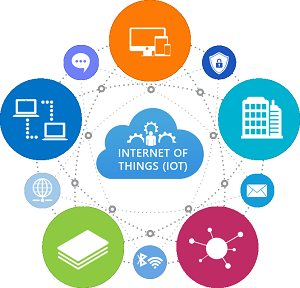
The Internet of things (IoT) is the network of physical devices, vehicles, home appliances, and other items embedded with electronics, software, sensors, actuators, and connectivity which enables these things to connect, collect and exchange data.

The internet of things, or IOT, is a system of interrelated computing devices, mechanical and digital machines, objects, animals or people that are provided with unique identifiers (UIDs) and the ability to transfer data over a network without requiring human-to-human or human-to-computer interaction.

CAREER & OPPORTUNITIES

  • Cloud management
  • Security solutions that cut across the IoT stack.
  • Communication gateways
  • Sensors
  • Domain knowledge that identifies and addresses problems with IoT
  • Communicative chips